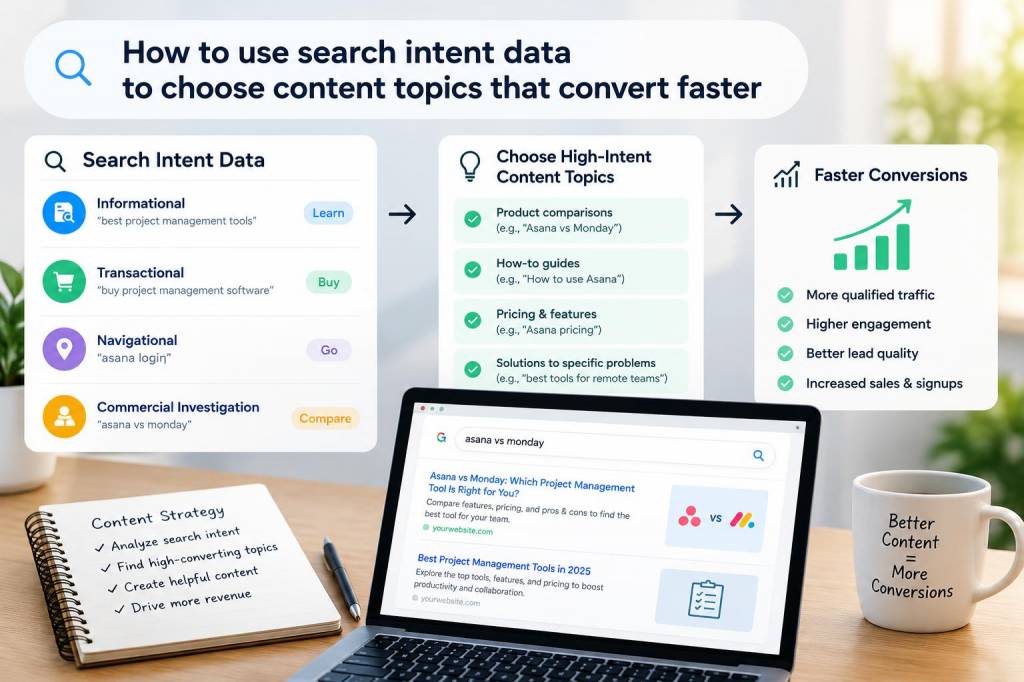
I have learned that content ideas become far more valuable when they are tied to search intent instead of guesswork. When I look at data before choosing a topic, I am not just asking, “Will people read this?” I am asking, “Will this page attract readers who are ready to act?” That shift changes everything. It helps me create content that does more than bring traffic; it brings qualified traffic that is more likely to subscribe, request a demo, buy, or take another meaningful step.
Search intent data is one of my favorite decision-making tools because it reveals what people actually want at a specific moment. A query can signal curiosity, comparison, research, or a buying decision. If I can identify that intent early, I can build content around it and reduce the time it takes for a page to start converting. I do not need to wait months to discover whether a topic was a good choice. The signals are often visible before I even publish.
Why search intent matters before I write anything
When I choose topics only by search volume, I often end up chasing attention rather than results. A keyword with high volume can look exciting, but if the searchers are not close to taking action, the page may attract visitors who leave without converting. I have seen this happen with broad informational terms that generate strong traffic but very weak business impact.
Search intent helps me separate interest from purchase readiness. If I know that a query is transactional, commercial, or problem-aware, I can match the content format to that intent. That means I can choose a topic that fits the current stage of the buyer journey and shorten the path from visit to conversion.
For me, that is the real power of intent data: it improves both topic selection and conversion efficiency. Instead of hoping the right audience appears, I deliberately build content for people who are already signaling a need.
What I look for in intent data
When I evaluate a keyword or topic, I pay attention to more than a single metric. I want to understand the behavior behind the search. These are the signals I check first:
- Query language: words like “buy,” “price,” “software,” “service,” “near me,” “compare,” or “review” often reveal stronger commercial intent.
- Current ranking pages: if search results show product pages, comparison pages, or vendor pages, the intent is probably more commercial than informational.
- Featured snippets and SERP features: these often show whether users want quick answers, lists, definitions, or deeper comparisons.
- Question patterns: “what is,” “how does,” and “why” usually indicate early-stage research, while “which,” “best,” and “vs” often signal evaluation.
- Audience fit: even if a keyword has intent, I ask whether the searcher matches my ideal customer profile.
- Conversion potential: I assess whether I can naturally include a next step that feels useful, not forced.
I do not treat these signals as isolated clues. I combine them. A keyword may have moderate search volume, but if the intent is clear and the audience is close to action, I often consider it more valuable than a larger, vaguer term.
My process for turning intent data into content topics
When I build a content plan, I like to move from data to decision in a structured way. I start by collecting keyword ideas from tools such as Google Search Console, Ahrefs, Semrush, and even the “People Also Ask” section in Google. Then I group those ideas by intent rather than by volume alone.
After that, I ask myself a simple question: what does this searcher want to do next? If the answer is “learn,” I may create an educational article. If the answer is “compare,” I may create a comparison page or a detailed breakdown. If the answer is “choose,” I may create a buyer-focused post with clear recommendations or decision criteria.
This approach helps me create content that feels aligned with the searcher’s mindset. That alignment matters because people convert faster when they feel understood. If a page gives them exactly what they expected, they are more likely to keep reading and move forward.
How I identify topics with faster conversion potential
Some topics simply convert faster than others. I have found that the strongest ones often sit closer to a decision point. For example, a search for “email marketing software for small businesses” usually carries more commercial intent than “what is email marketing.” Both topics are useful, but they serve different business goals.
I often prioritize topics that include:
- Comparison language
- Brand names or category names
- Cost, pricing, or budget terms
- Use-case modifiers like “for startups,” “for agencies,” or “for ecommerce”
- Pain-point language such as “avoid,” “fix,” “improve,” or “reduce”
These modifiers usually indicate that the searcher has moved beyond curiosity. They are trying to solve a specific problem or make a decision. That is where I like to focus when I want content to generate results sooner.
I also pay attention to intent mismatch. Sometimes a keyword looks promising, but the current SERP is filled with content that does not align with the business offer I want to promote. In that case, I may still write about it, but I will not expect fast conversions. I have learned to respect the intent behind the search results, not just the keyword itself.
My favorite way to map intent to funnel stage
I find it useful to connect search intent with funnel stage because it helps me choose the right content format. Here is the framework I use most often:
| Intent Type | Typical Search Behavior | Content Format | Conversion Potential |
|---|---|---|---|
| Informational | Learning, understanding, exploring | Educational article, explainer, glossary | Lower, but useful for awareness |
| Commercial | Comparing options, evaluating solutions | Comparison post, buyer’s checklist, case study | Medium to high |
| Transactional | Buying, signing up, requesting access | Landing page, product page, service page | High |
| Navigational | Looking for a brand or specific page | Brand page, login page, support page | Very high for branded users |
I use this structure to decide whether a content topic belongs in a blog article, a service page, or a comparison asset. That choice affects conversion speed more than many people realize. A great topic can underperform if it is published in the wrong format.
What I do with mixed-intent keywords
Some keywords contain more than one intent. I see this often with queries that sit between education and evaluation. For example, someone searching for “best CRM for freelancers” may want a definition, a shortlist, and pricing details all in one place. In those cases, I build content that respects the layered intent instead of forcing a single angle.
I usually structure these pages with a clear progression:
- A short answer near the top
- A practical explanation of the problem
- Evaluation criteria
- Option comparisons
- A direct next step
This structure helps me satisfy the searcher while still moving them toward action. It is one of the most reliable ways I have found to make content convert faster without sounding pushy.
My signals for choosing topics that deserve priority
I do not want every promising keyword. I want the keywords that deserve my time. To decide that, I compare intent data with business value. A topic becomes a priority when it satisfies several of these conditions:
- The searcher has a clear problem I can solve
- The topic aligns with a product, service, or offer
- The SERP shows commercial or decision-oriented results
- The topic can support a call to action without feeling unnatural
- The audience is a strong fit for my ideal customer profile
I also check whether the topic can be expanded into a cluster. A single page is useful, but a connected group of pages can build authority and accelerate conversions over time. For example, I may create one article for a high-intent query, then support it with related comparisons, use cases, and objection-handling content.
How I avoid wasting effort on low-conversion topics
I have learned that not every high-traffic topic deserves a place in my editorial calendar. Some ideas may attract readers who are too early in their journey, too broad in their needs, or too far from my offer. In those cases, I ask myself whether the topic is worth the effort right now.
When I want faster conversions, I avoid topics that are:
- Too broad to signal clear intent
- Dominated by informational SERPs with weak buying signals
- Unrelated to my service or product positioning
- Likely to attract curiosity traffic with little business value
- Difficult to connect to a meaningful next step
This does not mean I ignore top-of-funnel content. I still value it, especially for brand awareness and nurturing. But when my goal is faster conversion, I favor intent-rich opportunities first.
Why I like using real search results as a decision tool
Keyword tools are helpful, but I never rely on them alone. I always review the live search results because they reveal what Google believes the intent really is. If the top results all look like product pages, then an article written only for education may struggle. If the top results are long-form explainers, then a thin sales page may not perform well.
That is why I treat the SERP like a market survey. It shows me what kind of content already satisfies the searcher. I use that information to position my own page more intelligently and choose topics that are already aligned with demand.
When I combine keyword data, SERP analysis, audience fit, and conversion potential, I make better content decisions with less wasted effort. That process has helped me prioritize topics that bring qualified visits, stronger engagement, and more valuable actions sooner than content chosen only by volume or intuition.