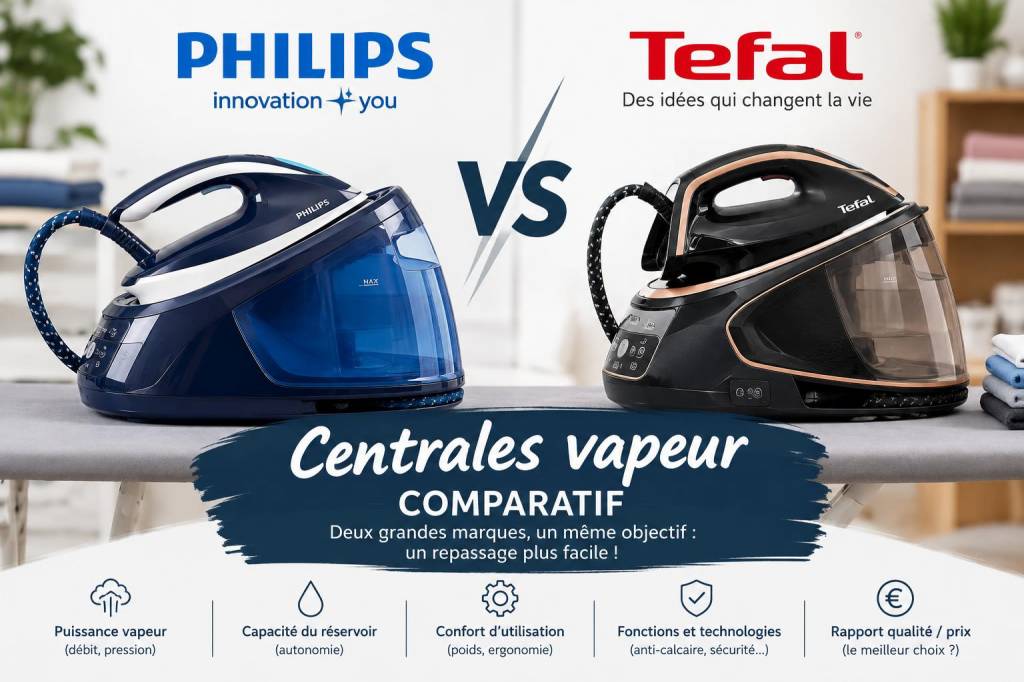
When I compare steam generators from Calor and Philips, I do not start with brand loyalty. I start with usage: ironing volume, fabric mix, storage space, budget, and how much time I want to save each week. That approach matters because a steam generator is not a simple purchase in e-commerce; it is a productivity tool. For readers who want a deeper technical breakdown, I recommend this comparatif centrales vapeur deux grandes marques, which gives a focused side-by-side view of these two major names.
In my experience, Calor and Philips occupy similar shelves but solve slightly different problems. Both brands offer high-pressure steam, fast heat-up, and integrated limescale management. Yet once I look closely at soleplate design, steam output consistency, tank handling, cord ergonomics, and maintenance routines, the differences become easier to see. If I am selecting for an online store, a content page, or a buying recommendation, those details matter because they influence conversion, returns, and long-term satisfaction.
What I look at first in a steam generator
I usually begin with four numbers: pressure, continuous steam output, water tank capacity, and heat-up time. These figures help me filter products quickly before I compare marketing claims. A steam generator with 7.5 bar pressure and 140 g/min continuous steam can perform very differently from a model with 8 bar and 130 g/min, depending on the soleplate and the steam distribution pattern.
- Pressure: higher pressure usually helps steam penetrate thicker fabrics.
- Continuous steam: this affects everyday ironing speed.
- Steam boost: useful for heavy creases and denim.
- Tank size: larger tanks reduce refills during long sessions.
- Heat-up time: shorter heat-up improves convenience for short tasks.
In current product ranges, both Calor and Philips frequently advertise around 7 to 8.5 bar pressure and steam boosts above 500 g/min on premium units, although exact figures vary by model and market. According to manufacturer specifications, that places both brands in a strong performance category rather than a budget one. In practical terms, this means I expect either brand to handle family laundry, shirts, bedding, and heavier textiles with ease.
Brand personality: how I separate Calor from Philips
I see Calor as a brand that often emphasizes powerful steaming, solid build feel, and practical ironing performance. Philips, by contrast, often focuses on convenience features, lightweight handling, and user-friendly maintenance systems. That is a simplification, of course, but it helps me frame the comparison.
For me, Calor products often feel slightly more “iron-first.” I mean that the ironing result itself is front and center. Philips often feels more “comfort-first,” with design details that make routine use easier for a wider range of households. Neither philosophy is superior in all cases. The right choice depends on whether I want raw ironing efficiency or a smoother overall user experience.
Soleplate technology and glide quality
The soleplate is one of the most underrated parts of a steam generator comparison. I have seen buyers focus on bar pressure while ignoring glide quality, and that is a mistake. If the soleplate catches on cotton seams or synthetic blends, the user experience declines quickly.
Calor often uses high-glide soleplates designed for durability and even steam spread. Philips frequently uses its own proprietary soleplate lines, such as SteamGlide variants, which are known for smooth movement and scratch resistance. In my reading of product behavior and user feedback, Philips often wins on effortless glide, while Calor can feel more assertive and industrial in use.
When I compare these in an e-commerce context, I pay attention to:
- scratch resistance
- edge precision around buttons and seams
- steam hole distribution
- ease of cleaning residue
For readers who iron many shirts and table linens, glide matters as much as steam volume. A smooth soleplate can save several minutes per session and reduce fatigue.
Steam power, fabric handling, and real usage
Real usage is where specs either prove themselves or collapse. I usually imagine three scenarios: a stack of cotton shirts, a mixed household wash, and a bulky set of curtains or bedding. Both brands can handle all three, but I notice differences in how quickly they recover steam after repeated bursts.
Philips often feels responsive in short, repeated passes. Calor often feels strong in sustained ironing, especially when the user wants to move through larger loads without frequent pauses. In many cases, a model’s water tank capacity matters as much as its pressure rating, because a larger tank supports longer sessions and fewer interruptions.
A useful rule I keep in mind is this: if the household irons for under 30 minutes at a time, convenience and heat-up time matter more. If the household irons for 60 minutes or more, stability, tank comfort, and limescale management become more important.
Maintenance, anti-scale systems, and lifespan
Steam generators fail in two ways: mechanical issues and neglected maintenance. That is why I spend time on anti-calc systems and water management. In this category, both Calor and Philips offer removable collectors, rinse systems, or built-in scale management depending on the model tier.
Philips has been especially visible with Easy De-Calc style systems on many models, while Calor often highlights removable collectors and maintenance alerts. I like removable systems because they make long-term ownership more realistic for people who do not want to spend much time on upkeep.
From a product-content perspective, I would describe maintenance priorities like this:
- Use filtered or recommended water when the manual allows it.
- Empty the tank after use if the manufacturer suggests it.
- Clean limescale regularly to preserve steam flow.
- Check descaling indicators rather than waiting for performance loss.
Energy Star and other appliance-efficiency resources regularly remind users that good maintenance supports lifespan and efficiency. For broader context, I also cross-check consumer advice from sources like Which?, Consumer Reports, and official manufacturer documentation from Philips and Calor.
Comparison table: practical differences I notice
| Criteria | Calor | Philips |
|---|---|---|
| Steam intensity | Often strong and direct | Often balanced and consistent |
| Glide feeling | Good, sometimes firmer | Very smooth on many models |
| Maintenance focus | Practical scale management | Very visible anti-calc systems |
| Ergonomics | Solid, functional | Often lighter and easier to handle |
| Use case fit | Heavy ironing sessions | Frequent household use |
What matters for e-commerce buyers and content strategy
Because I work in digital content and marketing, I also think about purchase behavior. Shoppers do not want a product lecture; they want confidence. So when I write or evaluate a steam generator comparison, I focus on decision triggers. The most persuasive factors are usually visible performance numbers, a clear maintenance promise, and a simple explanation of who the product suits.
In e-commerce, I would segment the audience like this:
- Busy families: want speed, tank capacity, and low maintenance.
- Frequent shirt wearers: want glide, precision, and crease removal.
- Occasional users: want easy storage and quick start-up.
- High-volume users: want durability and strong continuous steam.
That segmentation helps me explain why one brand may outperform the other for a specific buyer profile. It also improves SEO relevance because the content matches real intent, not just product jargon.
What specifications I would verify before buying
Before I buy or recommend any steam generator, I check the product sheet line by line. Some specs look impressive but have little effect in daily life. Others are modest but crucial.
- Bar pressure and steam burst
- Continuous steam rate in g/min
- Tank capacity in liters
- Heat-up time in seconds
- Weight of the iron unit
- Cord and hose length
- Auto shut-off function
- Anti-drip and anti-calc systems
I also pay attention to repairability and warranty terms. In a market where household appliances compete on slim margins, after-sales support can influence the real value more than a small difference in steam output. A model with slightly lower pressure but better service support may be a smarter buy over time.
My practical reading of the Calor and Philips matchup
If I had to summarize the matchup in plain terms, I would say this: Calor often appeals to users who want forceful, reliable ironing performance, while Philips often appeals to users who want comfort, glide, and easy maintenance. Both brands are credible and competitive. I do not see one as universally superior.
In a high-intent buying context, I would position the choice like this:
- Choose Calor if you prioritize strong ironing performance and a more utilitarian feel.
- Choose Philips if you prioritize smooth handling and convenience-oriented design.
- Compare exact model numbers rather than relying on brand reputation alone.
- Check descaling design if you live in a hard-water area.
- Match the product to your ironing volume, not to a generic “premium” label.
Questions I see most often from buyers
Is higher pressure always better? Not always. Higher pressure helps, but soleplate quality, steam consistency, and ergonomics can matter just as much.
Does one brand last longer? Longevity depends more on maintenance, water quality, and model quality than on brand name alone.
Which is easier for beginners? I usually find Philips slightly easier for first-time users because the design language often feels more approachable.
Which one is stronger on heavy fabrics? Calor often feels more direct on dense textiles, but specific models can reverse that impression.