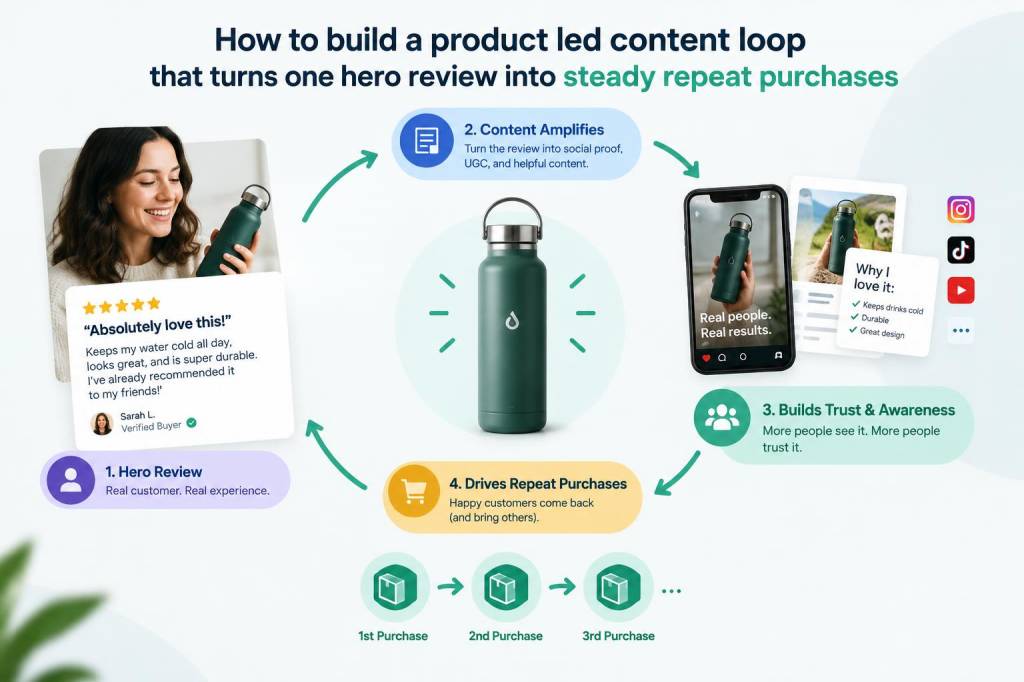
I still remember the first time a single glowing review changed everything for one of my product launches. It wasn’t the number of views that surprised me—those were modest—but the way that one authentic voice kept converting strangers into repeat customers for months. That day I started thinking beyond one-off reviews and toward building a product-led content loop: a repeatable, scalable machine that turns a single hero review into a steady stream of purchases and loyal users.
What is a product-led content loop?
For me, a product-led content loop is a content system where the product itself becomes the central source of stories, social proof, and micro-content. That content then attracts new prospects, converts them through authentic experiences (reviews, demos, user-generated content), and feeds back into the product via feedback and retention-driven content—creating a virtuous circle. The key word is product-led: the product creates the content rather than marketing creating content that pretends to be product-led.
Why one hero review can be enough
Not every business gets a glowing Wired review or a TechCrunch feature. But a single, well-timed, credible review—on YouTube, a niche blog, or even Instagram—can act as a catalyst. Why? Because:
Authenticity wins: People trust other users more than brand messaging.Repurposability: One story can be sliced into many formats—quotes, short videos, FAQs, case studies.Network effects: A review reaches networks you can’t pay to reach with the same authenticity.My job then is to turn that catalytic moment into ongoing momentum.
Core components of a product-led content loop
When I design these loops, I focus on five interconnected elements:
Hero content — the original review, case study or user story that demonstrates value.Micro-content — short clips, quotes, and visuals extracted from the hero content.Distribution nodes — owned channels (email, site), earned channels (social, publications), and paid amplification when needed.On-product experiences — in-app prompts, onboarding flows and product updates that reference the hero story or embed social proof.Feedback & retention hooks — encouraging new users to create their own micro-review, which restarts the loop.Step-by-step: turning one hero review into repeat purchases
Here’s the exact workflow I use when a hero review lands in our ecosystem. You can adapt every step to your product and audience.
1) Capture and canonicalize: Save the original review in multiple formats (video file, transcript, screenshot). Create a canonical version on your site—a dedicated review page or case study that you control. This becomes the loop’s nucleus.2) Slice the hero into micro-assets: Extract 10–20 pieces of micro-content: Short video snippets (10–30s) for Reels, TikTok, YouTube Shorts Quote cards for LinkedIn and Twitter Pullout stats for product pages and ads FAQ-derived content for support and onboarding3) Map distribution to intent: Top-of-funnel: Use short social clips and blog posts targeting discovery keywords. Consideration: Use the full hero case study and comparison content on your site and email nurture. Conversion/Retention: Display review snippets in checkout, onboarding emails, and in-app notifications.4) Optimize product touchpoints: Embed the hero review in places that influence purchase and retention: Checkout page: a rotating testimonial carousel that includes the hero snippet. Onboarding: a “How others use this” video module containing the hero review. In-app prompts: nudge new users to try a specific feature that was praised in the review.5) Close the loop by encouraging new reviews: Automated email + in-app flow 7–14 days after key usage milestones asking for feedback and offering a one-click way to submit a short video or quote. Reward public sharing with discounts, feature unlocks, or profile highlights (not fake incentives that harm authenticity).6) Measure and iterate: Track conversion lift from pages and touchpoints where the hero content is used, and measure the ratio of new reviews generated per campaign.Examples and tactical templates I use
I routinely repurpose hero content this way:
Email subject line: "How [Customer] cut onboarding time in half (3-min video)"Product page hero: Embed a 60s clip with a bold quote overlay and CTA to "See the full story."PPC creative: Use a 15s social snippet with the reviewer’s most concrete result—CTR and CPA usually improve because relevance and social proof are increased.Brands like Drift and Notion do this well—product moments become marketing channels. For smaller teams, tools like Descript for editing, Canva for visual assets, and Zapier to automate review collection help scale the work.
Metrics that matter
Don’t get lost in vanity metrics. I track a small set of KPIs to evaluate the health of the loop:
Conversion lift at pages using hero content vs control pages.Repeat purchase rate among customers who interacted with the hero content during onboarding.Review multiplier: new UGC pieces generated per hero asset promoted.Time-to-review: how long after acquisition users submit their first public piece of content.Pitfalls to avoid
From experience these mistakes cost momentum:
Overproducing hero content that feels staged—authenticity is non-negotiable.Not owning the canonical asset: if the original lives only on a third-party platform, you lose long-term SEO and control.Forgetting to make it easy to share—long, clunky submission flows kill UGC rates.Small-budget amplification tactics
You don’t need a huge ad budget to amplify a hero review. I’ve had success with:
Boosting one high-performing social clip for a narrow lookalike audience.Using SEO: optimize the canonical review page for buyer-intent long-tail queries (“Is X product worth it for Y?”).Micro-partnerships: ask niche creators to react to the review in exchange for early access or affiliate incentives.How I keep the loop alive over time
Once the loop is running, my ongoing playbook is simple:
Rotate hero content regularly so new visitors see fresh, relevant stories.Automate review solicitation tied to product milestones so content replenishes itself.Test variations of where and how the review appears (checkout banners vs. onboarding modals) and double down on what moves conversion and retention.When done right, a single review becomes less like a fleeting endorsement and more like a multipurpose asset that fuels discovery, drives conversion, and keeps customers coming back. It’s product-led growth with a content engine attached—and it’s one of the most pragmatic ways I’ve found to turn authenticity into sustainable revenue.