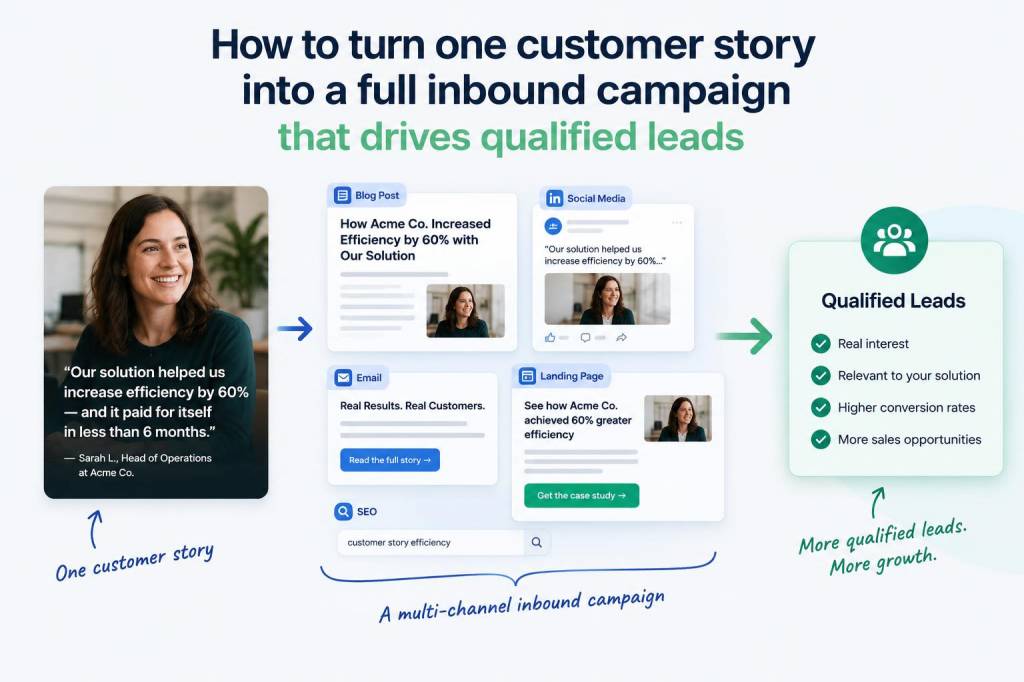
I have found that one customer story can do far more than fill a testimonial box on a landing page. When I treat it as a strategic asset, it becomes a source of messaging, content, proof, sales enablement, and organic traffic all at once. A single story can fuel a complete inbound campaign if I know how to extract the right details, shape them for different stages of the buyer journey, and distribute them across channels with purpose.
Why one story can carry so much weight
People do not connect with feature lists in the same way they connect with a real transformation. A customer story gives me a concrete before-and-after narrative, and that matters because prospects are usually trying to answer a simple question: Will this work for someone like me? When I build an inbound campaign around a story, I am not just promoting a product or service. I am showing evidence, context, and emotional relevance in one package.
I also like customer stories because they are naturally flexible. One interview can become a blog article, a case study, a short video, an email sequence, a webinar outline, social posts, ad copy, and sales follow-up material. That means I can invest deeply in one strong narrative and then multiply its value instead of starting from zero every time.
For me, the key is to stop thinking of the story as a single asset and start treating it as a content system.
Finding the right story before I create anything
Not every customer experience is ready to become an inbound campaign. I look for stories that have three qualities: a clear problem, a measurable result, and a transformation that my audience can recognize. If the customer faced a challenge that mirrors my ideal buyer’s pain points, I know the story has campaign potential.
I usually ask a few questions before I decide to build around it:
- What was happening before the customer found us?
- What triggered the search for a solution?
- Which objections almost stopped the purchase?
- What changed after implementation?
- Which result can be measured, not just described?
Those answers help me identify the emotional and practical angles. Some stories work because they are about speed. Others work because they are about cost savings, team confidence, revenue growth, time recovery, or reduced stress. I want the campaign to reflect the real reason the customer cared, not just the polished final outcome.
Turning interview notes into campaign messaging
When I interview a customer, I do not only listen for quotes. I listen for language patterns. The words they use reveal how they think about the problem, and that language is gold for inbound marketing. If a customer says, “We were drowning in manual work,” that phrase is more powerful than a generic line about efficiency. It tells me exactly how to frame the pain point.
I then turn the story into a messaging map. I break it into three parts:
- Problem: what was broken, frustrating, or expensive
- Process: what changed and what made the difference
- Outcome: what improved and why it mattered
This structure gives me a repeatable framework for every campaign asset. A blog post can focus on the problem. A video can emphasize the process. A landing page can lead with the outcome. Email messages can move prospects through those stages in sequence.
I also use the customer’s own phrasing in headlines, subheads, and supporting copy whenever possible. That helps the content feel real and gives me a better chance of resonating with readers who have the same concerns.
Building a content ecosystem around one story
Once I have the story and the message, I build a content ecosystem. I do not publish one article and hope it performs. I create a set of connected assets that reinforce one another and move prospects deeper into the funnel.
Here is the structure I often use:
| Asset | Role in the campaign | Primary goal |
|---|---|---|
| Long-form blog article | Explains the story in detail and targets search intent | Attract organic traffic |
| Case study page | Provides proof, metrics, and structured narrative | Support evaluation and conversion |
| Lead magnet | Expands the story into a downloadable asset | Capture leads |
| Email sequence | Delivers the story in small, persuasive steps | Build trust and nurture interest |
| Short-form social content | Highlights key lessons and proof points | Increase reach and engagement |
| Sales one-pager | Summarizes the story for sales conversations | Help close qualified leads |
What I love about this structure is that it creates consistency. The same core narrative appears in different formats, but each format serves a different intent. Search visitors get depth. Email subscribers get momentum. Sales teams get a clear proof asset. Prospects see the story more than once, but never in exactly the same way.
Using search intent to attract qualified traffic
If I want a customer story to drive qualified leads, I cannot rely only on emotional appeal. I also need search visibility. That means I think carefully about the intent behind the keywords I want to target. A story about a client’s success with SEO, content, automation, or conversion optimization can rank for problem-aware searches if I frame it properly.
I usually look for phrases that suggest active research, such as:
- “how to improve lead quality”
- “reduce sales cycle with content”
- “customer success example”
- “case study for inbound marketing”
- “increase organic leads with content”
Then I align the article with the problem the reader is trying to solve. I avoid making the piece too promotional. Instead, I focus on the journey, the obstacles, and the measurable result. Search engines tend to reward useful, specific content, and readers reward clarity. When both are aligned, the story becomes a discovery asset as well as a persuasion asset.
I also make sure the page includes supporting context around the story so it does not feel thin. That can include process details, lesson summaries, and practical takeaways that are useful even for people who are not ready to buy yet.
Repurposing the story across channels without losing consistency
Repurposing works only when I keep the core narrative intact. I do not change the facts just to fit a channel. Instead, I adjust the angle. A LinkedIn post might focus on one surprising insight from the story. An email might focus on the emotional shift. A webinar invite might emphasize the measurable result. A landing page might highlight the business impact and the proof.
I like to think of each channel as a different doorway into the same room. The story stays consistent, but each doorway highlights a different reason to enter.
A simple repurposing flow can look like this:
- Start with a recorded interview
- Pull out memorable quotes and metrics
- Write a long-form narrative article
- Create a shorter case study version
- Turn key lessons into social snippets
- Use the main result in email nurture content
- Give sales a short version for direct conversations
This approach saves time, but it also increases recognition. Prospects may first discover the story in a social post, then read the article later, then see the case study in an email. That repeated exposure builds familiarity and trust.
Making the story conversion-ready
A strong inbound campaign needs more than visibility. It needs a clear next step. I always ask myself what action the reader should take after engaging with the story. That action might be booking a demo, downloading a related resource, subscribing to email updates, or requesting a consultation. The important thing is that the next step feels like a natural extension of the story.
I make conversion easier by placing relevant calls to action near the most persuasive moments. If the story highlights a clear pain point, I offer a resource that helps solve it. If the story demonstrates a major result, I invite the reader to see how that outcome could apply to their own situation.
I also pay attention to friction. If the form is too long or the offer feels too generic, the campaign loses power. Qualified leads respond better when the next step is specific, useful, and connected to what they just read. A story about growth should not lead to a vague contact form. It should lead to an offer that continues the conversation.
Measuring whether the campaign is attracting the right leads
I do not judge success only by traffic. I look at lead quality, engagement depth, and conversion behavior. A story can bring in many visitors, but if they are not a match for the business, the campaign is not doing its job. I care more about the right people than about vanity numbers.
These are the signals I watch:
- Organic search impressions for problem-based queries
- Time on page and scroll depth on the story article
- Email click-through rates from story-driven sequences
- Lead source quality in the CRM
- Demo or consultation requests from story-related content
- Sales feedback about prospect fit and awareness level
When I see strong engagement but weak conversion, I usually inspect the offer, the audience targeting, or the call to action. When I see strong conversion but low volume, I revisit search intent and distribution. The campaign should balance reach with relevance.
I have learned that one customer story is often enough to launch a full inbound campaign if I respect its structure and let it work across formats. The story becomes a source of proof, a source of keywords, a source of trust, and a source of lead generation. When I build around real transformation instead of generic marketing language, the result feels more human and performs better for the business.