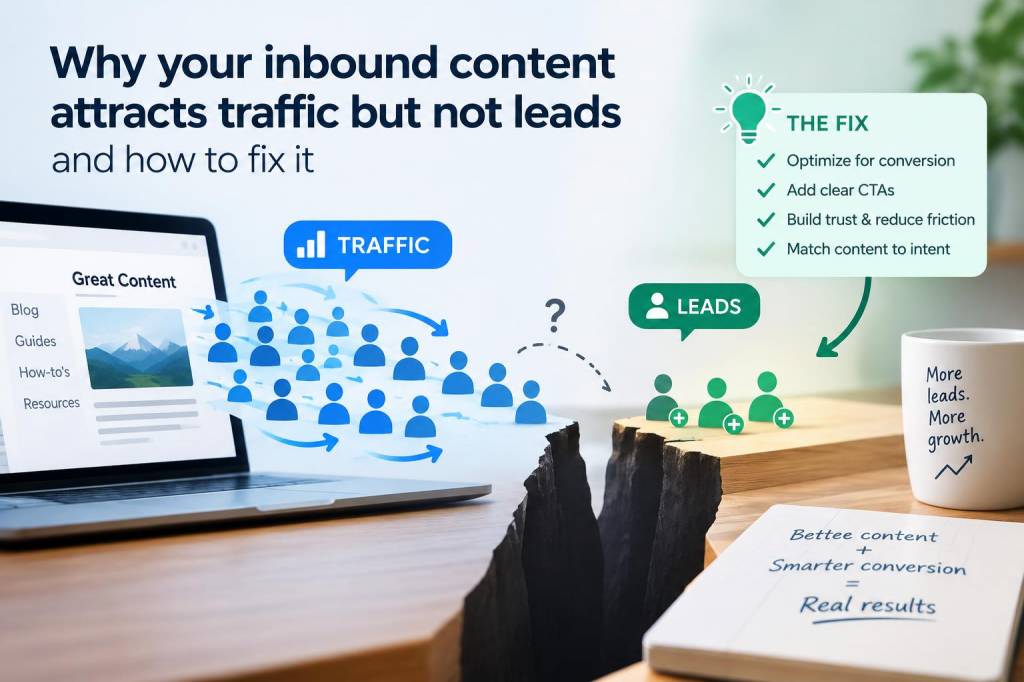
I have seen this pattern many times: a content program starts bringing in steady traffic, search rankings improve, social reach grows, and email signups appear here and there, yet sales conversations stay flat. That gap can feel frustrating because it looks like everything is working. In reality, traffic alone is only a surface signal. If visitors arrive and leave without taking a meaningful next step, your inbound content is acting like a strong magnet with no path forward.
When I audit content systems, I usually find that visibility is not the problem. Clarity is. Readers find an article, skim it, maybe enjoy it, and then move on because nothing in that experience clearly connects their interest to a next action. If content is built only to rank, it often attracts broad curiosity instead of qualified demand. That is why so many pages generate sessions but fail to create leads.
Why traffic does not automatically become leads
Traffic is a volume metric, while leads are an intent metric. Those are not the same thing. A page can rank for a popular keyword, answer a common question, and still miss the deeper problem your ideal customer wants solved. I often see content that attracts people who are researching, learning, or comparing, but not yet ready to engage with a business. That is not a failure in itself, but it becomes one when no bridge exists between education and conversion.
Another issue is message mismatch. A visitor may click because your headline promises one outcome, but once they land on the page, they discover a more generic article that does not speak to their specific pain point. If your content does not mirror the reader’s language, priorities, and urgency, it will not feel relevant enough to earn a lead action.
Sometimes the problem is structural. A post may contain useful information, but no clear call to action, no internal path to a related offer, and no visible reason to continue engaging. In that case, people consume the content and exit. They never reach a landing page, never download a resource, and never book a call because no conversion route was built into the experience.
Where content usually breaks down
In my experience, poor lead generation from inbound content usually comes from a few recurring mistakes:
- Targeting keywords with high search volume but weak commercial intent
- Writing for search engines first and readers second
- Using broad topics that do not match a specific offer
- Hiding calls to action until the very end of a long page
- Sending all visitors to a homepage instead of a focused next step
- Failing to segment content by audience stage
- Not building trust with proof, examples, or strong point of view
Each of these issues can quietly reduce lead quality. A page may still rank well, but if it attracts an audience that is too early in the journey, too general, or too disconnected from your service, the lead count stays low.
Search intent and buyer intent are not identical
This is one of the most important distinctions I look at. Search intent tells me what a person wants from a query. Buyer intent tells me whether that person is moving toward a decision. A phrase like “what is content marketing” may bring a lot of traffic, but it usually sits near the awareness stage. A phrase like “content marketing agency for SaaS” signals a much stronger commercial mindset.
That does not mean awareness content is useless. Far from it. Awareness content creates reach, builds authority, and introduces your perspective. But if you want leads, you need a mix of content that serves each stage of the journey. I like to think of it as a layered system: educational pages attract attention, comparison pages build consideration, and decision-focused pages convert interest into action.
When every article behaves like an educational explainer, your traffic may grow while your lead pipeline stays thin. If your content program is designed without intentional stage mapping, you are likely getting visits from people who are interested in a topic but not in a solution.
What I change when a content page gets traffic but no leads
My first move is to inspect the offer behind the content. A page needs a next step that feels natural. If someone just learned something useful, what should they do next? Download a checklist? Request an audit? Read a case study? Book a strategy call? The action must match the reader’s level of readiness.
I also review the opening section. If the first paragraphs are vague, long, or too abstract, readers disconnect quickly. I want the page to tell visitors exactly what problem it addresses, who it is for, and what outcome is possible. If that clarity is missing, the rest of the article has less power.
Then I look at proof. People do not convert because information is available. They convert because they trust you. I add concrete examples, data, mini case studies, before-and-after scenarios, or personal experience that shows real-world understanding. Trust is often the missing ingredient between an engaged reader and a lead.
How I turn content into a lead system
I think of inbound content as a path rather than a library. Each page should do one of three things: attract, qualify, or convert. If it only attracts, it needs support from other pages. If it qualifies, it should point to a stronger offer. If it converts, it should remove friction and make action easy.
A practical way to build this is by connecting your articles to a clear content journey. For example, a broad educational article can link to a deeper comparison page, which can then link to a landing page with a specific offer. This creates movement. Without movement, traffic just sits there.
I also pay attention to internal linking. Many teams add links randomly, but I use them strategically. I want each article to guide readers toward a relevant next step based on what they already care about. A well-placed internal link can outperform a generic button because it feels like a natural continuation of the conversation.
What a stronger conversion experience looks like
If I want more leads from inbound content, I make sure every important page answers a few simple questions very quickly:
- Why should I trust this source?
- Is this relevant to my problem?
- What should I do next?
- What will I get if I act now?
That means I need a visible offer, a clear promise, and a reason to take action. The offer does not need to be aggressive. In fact, softer conversion points often work better for informational content. A diagnostic quiz, a downloadable framework, a checklist, a webinar, or a short assessment can feel more appropriate than a hard sales pitch.
I also like to place calls to action throughout the page, not only at the end. Readers do not all finish an article. Some are ready earlier, some later, and some may need a subtle reminder after a useful insight. If the page waits too long to offer a next step, many visitors will leave before reaching it.
Where measurement can reveal the real problem
Analytics can be deceptive if you only watch sessions and impressions. I prefer to look deeper. Scroll depth, click-through rate, time on page, assisted conversions, and exit pages all tell me something different. A page with strong traffic and weak engagement may have a relevance issue. A page with strong engagement and weak conversion may have an offer issue. A page with high click activity but poor lead quality may have an audience mismatch.
Here is a simple comparison I use when reviewing underperforming content:
| Traffic Pattern | Likely Issue | What I Adjust |
| High visits, low scroll depth | Weak opening or poor keyword match | Rewrite introduction and align topic with intent |
| Strong engagement, low leads | Weak offer or unclear call to action | Add clearer next step and better placement |
| Low quality leads | Audience mismatch | Refine target keywords and content angle |
| Good leads from few pages | Uneven conversion design | Replicate winning structure across more content |
Why emotional relevance matters in inbound content
People do not become leads because they admire your keyword strategy. They become leads because your content reflects a problem they care about solving right now. That is why emotional relevance matters. I want readers to feel understood. I want them to recognize their own situation in my words. When that happens, content stops being generic information and becomes a signal of fit.
This is especially important in business and marketing content, where many pages sound polished but forget the reader’s real frustration. If your content only speaks in broad industry language, it may sound competent yet still fail to create action. Specificity is what makes people lean in.
I try to write in a way that acknowledges hesitation, urgency, uncertainty, and ambition. Those feelings drive decisions. When content addresses them honestly, readers are more likely to stay, trust, and convert.
Simple changes that usually improve lead generation
When I want a quick improvement, I focus on a few high-impact changes:
- Rewrite headlines to match a clearer problem or outcome
- Add a stronger offer near the first third of the page
- Use internal links to move readers toward deeper intent pages
- Replace generic CTAs with action-specific ones
- Insert proof points that reduce doubt
- Align each article with a single conversion goal
These changes do not require a complete content rebuild. Often, a page already has enough traffic to produce leads once it is better structured. I have seen a single improved CTA, a more focused headline, or a better matching lead magnet shift results significantly.
What matters most when fixing the gap
If your inbound content attracts traffic but not leads, I would not rush to publish more articles immediately. I would first ask whether the current content has a real conversion path, a relevant offer, and enough trust-building depth. I would also ask whether the content attracts the right audience, not simply a large audience.
That shift in thinking changes everything. Content should not only bring people in. It should move them forward. If a page earns attention, it has already proven that interest exists. My job is to make sure that interest has somewhere meaningful to go, and that every useful page earns its place in a connected system that supports action.