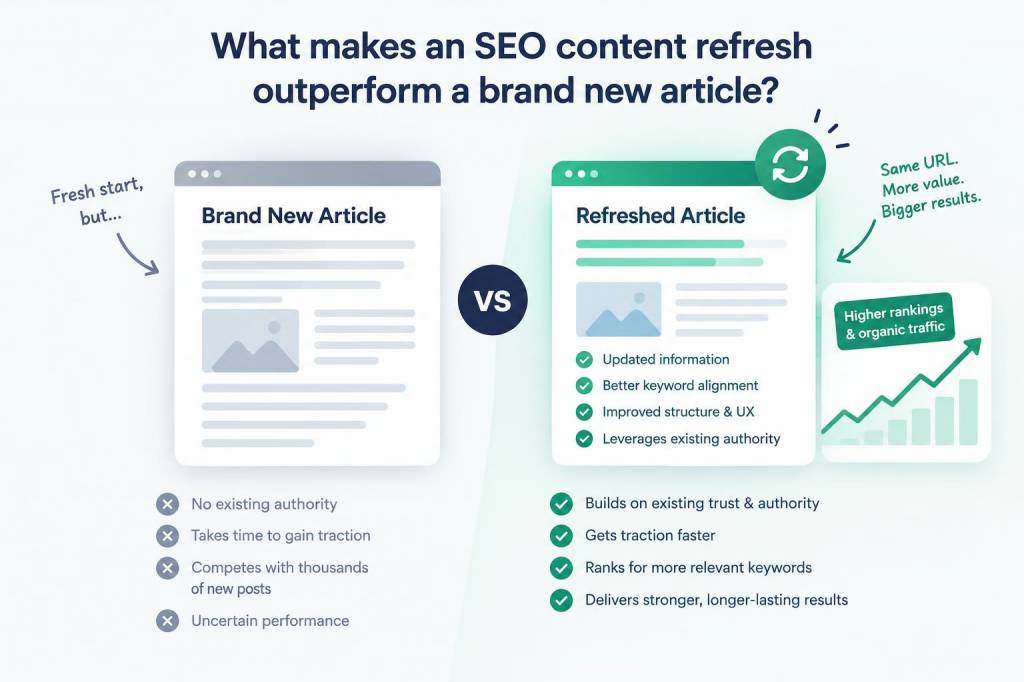
I have seen one pattern repeat across countless websites: a carefully refreshed page often outruns a brand new article, even when both target similar queries. At first, that can feel counterintuitive. New content seems exciting, and publishing something from scratch feels like progress. Yet when I compare performance over time, a well-executed content refresh usually wins because it starts with existing authority, existing history, and existing signals that search engines already trust.
What matters most is not whether a page is new or old. What matters is whether it matches search intent, earns engagement, and gives search engines enough confidence to rank it above competing pages. A refresh can do that faster because it is not starting from zero. It is improving something already known, already indexed, and often already linked. That creates a real advantage.
Existing Authority Gives A Head Start
When I update an existing article, I am working with a page that may already have backlinks, user engagement data, and historical relevance. Those signals matter. Search engines do not treat every page equally. A page with a track record has context. Even if its rankings slipped, it may still sit on a foundation that a brand new post cannot match on day one.
I often notice that older URLs have some of the hardest work already done. They may be indexed, they may have accumulated mentions, and they may have built topical associations over time. A refresh lets me preserve that equity while improving what is weak. A new article, by contrast, must earn visibility from the ground up.
This is especially important in competitive niches. If I publish a fresh post in a crowded topic, I am competing with pages that may have years of authority. If I refresh a page that already has traction, I can often move faster because search engines are already familiar with it.
Content Freshness Is More Than A New Date
One of the biggest mistakes I see is treating a refresh like a cosmetic update. Changing a publication date without changing substance rarely moves anything. Search engines are more sophisticated than that. They care about usefulness, completeness, and relevance. If a page was thin before, it stays thin unless I improve the depth. If it was outdated, it needs facts, examples, and structure that reflect current reality.
What makes a refresh outperform is not age alone. It is relevance plus history. I can update examples, add missing subtopics, strengthen internal links, improve headings, and answer new questions people are asking now. That combination can produce a stronger page than a new post, especially if the existing page already has ranking signals.
I also pay attention to freshness in a practical sense. Search intent changes. SERPs evolve. New competitors appear. When I refresh content, I am not just polishing language. I am adapting the page to what users now expect to see.
Search Intent Becomes Easier To Match
A brand new article often starts with a guessing problem. I need to predict what people want, what format will win, and how detailed the page must be. A content refresh removes some of that uncertainty because I can inspect actual performance data. I can see which queries already bring impressions, where people drop off, and which sections fail to hold attention.
That data gives me a direct path to improvement. If users land on a page and leave quickly, I know the intro is weak or the intent is misaligned. If people click but do not scroll, I know the opening may not promise enough value. If impressions are strong but clicks are low, I know the title or meta description needs work. A refresh lets me fix those problems with precision.
This is one reason refreshed content often beats something new. I am not building blindly. I am optimizing based on evidence.
Internal Links Can Create A Stronger Web Of Relevance
When I refresh an existing page, I usually have more opportunities to strengthen internal linking. Older content often sits in a broader site structure already connected to related pages. By updating that network, I can send stronger topical signals to search engines and guide readers to deeper resources.
Internal links help in two ways. First, they distribute authority across the site. Second, they help readers move naturally from one relevant topic to another. That movement can improve time on site, reduce friction, and reinforce topical clusters. A new article may have to wait for those connections to grow. A refreshed article can immediately benefit from them.
I often add links to newer supporting pages, older cornerstone content, and related product or service pages when it makes sense. That turns one improved article into a stronger hub rather than a standalone post.
Click Behavior Often Improves After A Refresh
In my experience, one of the quickest wins from a refresh comes from improving click-through rate. If a page already appears in search results, I can rewrite the title, adjust the meta description, and sharpen the opening line to better match what searchers want. That alone can make a measurable difference.
People often respond to clarity. If a page promises a direct answer, a practical framework, or a more current perspective, clicks tend to rise. Search engines notice that behavior. A refreshed article can earn better engagement signals than a new article that has yet to prove itself.
I have seen this happen repeatedly with pages that were already ranking on page two or lower positions on page one. A better title and a more focused introduction can lift performance more quickly than launching a fresh page and waiting for it to gain traction.
A Refresh Lets Me Upgrade Content Quality Without Losing Momentum
One advantage I value deeply is continuity. A refresh allows me to improve quality while keeping the page’s existing momentum. That matters because a new article may take time to collect impressions, even if it is excellent. A refreshed article can often build on what is already there.
When I audit a page for refresh potential, I usually look for:
- Outdated data or examples
- Sections that are too thin
- Questions the article does not answer yet
- Poor engagement on specific sections
- Weak internal linking opportunities
- A title that no longer matches search demand
If I find several of those issues, I know the page has room to improve significantly. That is often where a refresh becomes powerful. I am not merely editing. I am raising the page’s overall usefulness and search relevance.
Data Usually Tells Me Which Pages Deserve A Refresh
I do not refresh every article equally. I prioritize pages with signals that suggest upside. A page with steady impressions but weak clicks is a strong candidate. So is a page with decent rankings but declining traffic. Sometimes a post still has a good topic, but its formatting is poor, its examples are stale, or its angle no longer matches current search behavior.
When I compare a refresh opportunity with a brand new article, I ask a simple question: which one already has a path to visibility? If one page has existing impressions, indexed history, backlinks, or a recognizable topic footprint, I often choose the refresh first. New content can still matter, but it should not distract from obvious wins already sitting in the archive.
I also look at competitive movement. If rivals are updating their pages regularly, leaving an older article untouched can create a slow decline. A refresh helps me stay competitive without constantly chasing novelty for its own sake.
Why A Refresh Can Convert Better Than Fresh Content
Performance is not only about rankings. It is also about what happens after the click. A refreshed article can convert better because I can align it more closely with current reader intent and business goals. I can update the offer, improve calls to action, clarify product relevance, and remove confusion.
That is one reason a refresh often outperforms a brand new article in a business context. The page already has a role in the funnel. It may already attract readers at a useful stage of awareness. By improving that page, I can turn existing traffic into more meaningful action.
For example, if an article already attracts readers researching a solution, I can refine the messaging so it naturally leads to a service page, a demo request, or a newsletter signup. I do not need to wait for new traffic from scratch. I work with traffic already arriving.
| Factor | Content Refresh | Brand New Article |
|---|---|---|
| Existing authority | Often already present | Starts at zero |
| Indexing history | Already established | Must be built |
| Ranking potential speed | Often faster | Usually slower |
| Data for improvement | Available immediately | Limited at first |
| Conversion opportunities | Can be upgraded on known traffic | Depends on future discovery |
Refresh Work Rewards Precision More Than Volume
One thing I have learned is that SEO success does not always come from producing more content. Sometimes it comes from making current content substantially better. A refresh rewards precision. It rewards observation. It rewards the ability to listen to data and respond with useful edits.
That does not mean new articles are unimportant. I still publish new content when I need to enter a topic, target a fresh keyword set, or expand topical coverage. But when I want a page to outperform, I often start by asking whether an existing article can be made stronger first. In many cases, the answer is yes.
The pages that outperform after a refresh are usually the ones that gain more depth, better alignment, clearer structure, stronger internal links, and a more current angle without losing their accumulated value. That is why a thoughtful refresh can become one of the highest-return actions in my SEO workflow.